Posts

Showing posts with the label Ottomans

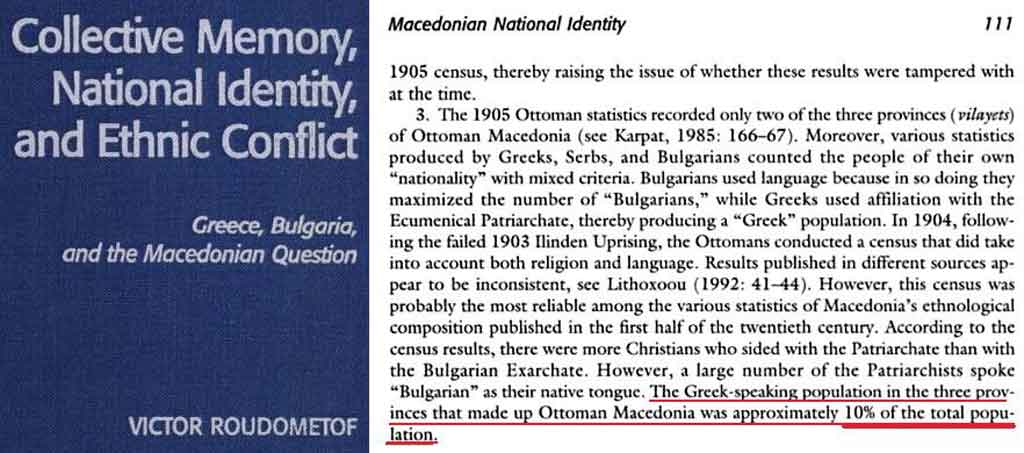
Only 10 percent Greek-speaking residents in Ottoman Macedonia
Image
 Victor Roudometof examined the statistics of the Ottoman Empire in relation to "Ottoman Macedonia". According to him, in these three Ottoman provinces, only 10 percent of the total population spoke the Greek language. In a nutshell: Victor Roudometof is visiting professor at the Institute of Sociology, Gerontology and Anthropology at Miami University, Oxford, Ohio. His earlier publications include nationalism, globalization, and orthodoxy (Greenwood, 2001), which is quoted here. In that work, Roudometof briefly comments on the language distribution in Ottoman Macedonia, e.g. on all three vilayets (Ottoman administrative districts) that made up Macedonia's territories, these are also called "Macedonian vilayets". The author claims that in these three administrative districts, probably only 10% of the population spoke Greek. Quote: The 1905 Ottoman statistics recorded only two of the three provinces (vilayets) of Ottoman Macedonia. Moreover, various statistics pr...

Eleftherios Venizelos and Ataturk talked about Macedonians - British Secret Report

Image
  Not only that the then two leaders of Turkey and Greece had spoken about the Macedonians, the Greek Prime Minister Eleftherios Venizelos said he wanted to grant the Macedonians "schools and minority rights"! The Macedonian-Australian journalist Sasa Uzunov discovered a spectacular document in the National Archives of Australia. Quite a few secret reports from the British Foreign Office at the time are kept there; these have now been declassified and made available to the public. Such a secret report of September 30, 1933 shows that the Greek Prime Minister Venizelos knew exactly who the Macedonians were - neither Serbs nor Bulgarians. Even more, Venizelos gave an approximate number of ethnic Macedonians in Northern Greece who were then still living in Northern Greece. The number he estimated was "around 60,000". One should note, however, that the number seems small at first glance, but is due to the population exchange from 1923. The kingdom of Greece had occupied...

Macedonian troubles - 1908

Image
 MACEDONIAN TROUBLES. The European Governments are still wrestling with the Macedonian problem, but whether there will be any practical outcome is problematic. It is said that they are in agreement, but we have been told that so often that there is some excuse for skepticism. The Porte has urged Greece to restrain the raids made by the Greek bands, and there is no doubt that if the Greek Government was in earnest it could do much to stop the cut-throat business which is going on. What between Greek, Bulgar, and Turk, the unfortunate Macedonian has been mercilessly massacred and oppressed. There will be no hope of reform until some authority is established which has not only the power, but the will, to compel the warring elements to keep the peace. Turkey maintains an armed force in the district, and the cost of maintenance of this force is one of the first charges on the Macedonian revenues. But about all the force seems to accomplish is to harass the unfortunate villagers. If th...

The Sydney Mail 1903 - The Rebellion in Macedonia

Image
 In August 1903 the Macedonians rose against Ottoman rule. The Turks brutally suppressed the uprising, after which there were countless attacks on the population. By regular Ottoman troops, but also by irregular formations consisting of Albanians in the service of the Ottomans. The Sydney Mail and New South Wales Advertiser reported on Wednesday, September 23, 1903, about "terrible excesses by Turkish troops, particularly the Albanians, in the vilayets of Bitola and Adrianople". The Ottomans named an administrative district as a vilayet, which they in turn introduced as an occupier. The Rebellion in Macedonia. Austria and Russia have protested to Turkey against the horrible' excesses of Turkish troops, especially of Albanians, in the vilayets of Monastir and Adrianople. Some Albanians have been recalled, and sent to their homes. A general insurrection has been proclaimed in that portion of the vilayet of Salonika eastwards of the River Vardajr. The district has been subdi...

German paper described 'Albanian atrocities against Christians in Skopje' 1844

Image
  A report from Skopje in the Bavarian press dating from 1844. The article describes atrocities committed by Albanians in the Skopje region. Turkey - A correspondence of the Times from Constantinople on March 27 assures that the Russian envoy had in the note which he handed over in relation to the atrocities perpetrated by Albanians against Christians in the district of Skopia or Uskub (Sanjak in Vilayet Rumili) most emphatic words demanded that the same should explain what means it was inclined to use in order from now on to protect its Christian subjects from the iniquities of the Mohammedan mob. If the answer is unsatisfactory, Russia threatens armed intervention. The same Russian note is said to have made further demands "in favor of the Christian Raja", namely that the office of the ecumenical patriarch of the Greeks in Constantinople should no longer be conferred by the Porte, but made hereditary. (The English correspondent is not very satisfied with this request, as it...

The turbulent Balkans and the Macedonian Question - 1903

Image
THE TURBULENT BALKANS. When the Macedonian Committee announced last winter that an uprising would take place in Macedonia in the spring the diplomatists of Europe hastened to arrange means fur preventing the outbreak. Their efforts were crowned with so much success that the Sultan premised reform and the committee called off the dogs of war. Thereupon Europe settled down with quiet satisfaction, gave due credit to the diplomatists and looked forward to a springtime undisturbed by anything more serious than a labor strike. There was, however, one factor in the problem that was not counted in the solution, and now that factor is making more trouble than the Macedonian Committee itself.  Long ago a wise man said that the Eastern question is in its last analysis a religious question, and that in comparison with the religious complications politics and pan-Slavism cut very little figure. The present disturbances go far to confirm that theory. The promise of reform in the in...

Thousand Macedonians Killed - 1903

Image
1000 MACEDONIANS KILLED. HOLY WAR SUGGESTED. LONDON, Monday. Prince Ferdinand starts immediately for Sofia from Vienna, where he has been staying on a visit. It is reported at Belgrade that a number of Turks and Albanians demolished a monastery at St. Prochov, on thn Servian frontier. Advices from Salonika report that six battalions of Turks and 3000 Macedonians met at Smilovo. The Turks killed 1000 Macedonians, and the rest fled. It is reported that fanatics in the towns of Tetovo and Kossovo urge the Moslems to institute a holy war against the Christians. SOURCE:  The Hamilton Spectator (Vic. : 1870 - 1918)  Tuesday 1 September 1903,  Page 3

The Pope on Macedonia - Interview with Pius X 1904

Image
THE POPE ON MACEDONIA.  INTERVIEW WITH PIUS X.  'GOOD WORK. FOR THE FREE PRESS.' Mr. George Lynch supplies to Mr. Stead's new organ, The Daily Paper, a report of an interesting audience he had last month with Pope Pius X. ! The Papal Reception 'My object in seeking the interview,' he writes, 'was to bring before the attention of the head of the Catholic Church the present woful condition of' the Macedonian Christians. I was introduced by the head of the Irish College. As we entered the Pope's apartment all the pomp and ceremony of the court seemed to be left behind. -The small room 'we entered was a plain one. There was a writing table on which was a crucifix and an inkstand. His Holiness had risen, and was standing beside and behind the table. I knelt and kissed his hand, and immediately he bid me rise, drew a chair close to his own, and motioned us to be seated as he faced his own chair round towards us. His reception was a...

The Secrets of America: Americans wanted Independent Macedonia in 1783

Image
The state entity called “The United States of America” in the dawn of its existence had such fortune to have as key persons deserving for its genesis extraordinary eruditi, exceptional lawyers, pragmatic diplomats and such personalities worthy of filling the top ranks of any nation. Among the pléiade of the most important figures for the genesis of the USA and the first decades of its existence and its establishment on the international scene are the world famous names of George Washington, Thomas Jefferson, Benjamin Franklin, as well as a few other persons among which certainly for his importance and contribution belongs John Adams. John Adams is one of the most famous and most appreciated American statesmen and diplomats. He is one of the seven “Founding Fathers of the United States of America” , initiator and signatory of the worthiest American document, “The Declaration of Independence” as well as the Constitution of the USA. He was the man who served as the first ever vi...

The old town crier of Drama has out-cried Turk, Bulgar and Greek occupations - 1920

Image
The old town crier of Drama, the capital of Eastern Macedonia, has out-cried Turk, Bulgar and Greek occupations. There being no "extras," his mission is to keep people posted on local news. The fountain (to the right) is in the principal square. In 1914 the town boasted a population of 25,000, of which 4,000 died of hunger and disease under Bulgarian rule . Summary Photographs show town crier and other people in a town square in Drama, Eastern Macedonia, Greece. Contributor Names Rohe, Alice, 1876-1957, photographer Created / Published 1920. Subject Headings -  Town criers--Greece--Drama--1910-1930 -  Plazas--Greece--Drama--1910-1930 Format Headings Periodical illustrations--1910-1930. Photomechanical prints--1910-1930. Notes -  Illus. in: "Snaps of Macedonia," Travel. New York : Robert McBride & Company, 1920, vol. 35, no. 1, p. 13. -  Title from item. Medium 2 photomechanical prints on 1 p. Call Number/...

THE TRAGEDY AT MACEDONIA - a European scandal 1907

Image
The Tragedy at Macedonia: A EUROPEAN SCANDAL by The Maitland Weekly Mercury, Sat 28 Sep 1907,  Page 13 One of the most 'pungent bits of journalistic literature during the month (says 'life') is Mr. llarold Spender's description of the state of things in Macedonia, in the London 'Daily Chronicle':  'It is the most amazing thing in the world to-day.' A whole' piece of Europe is relapsing into primitive anarchy. While the Powers are ingeminating peace at the -Hague', a great country, at the other end of their estates, is falling back into utter and horrible barbarism. Over a territory of 44,000 square miles massacre has become a virtue and deeds of nameless ferocity a form of competing' patriotism. Secure in her mate rial comforts, Europe looks on placidly at the murder and torture of innocent peasants. 'The news from Macedonia grows worse every day. Favoured by Turkey, the Greek bands, splendidly financed and organised—of...

Razlovci church serves as testament of the bravery of 19th century rebels

Image
With its foundations almost two meters underground, the church dedicated to the Emperor Constantine and the Empress Helena in the Delcevo village of Razlovci, eastern Macedonia, nowadays is still proudly telling its story about the courageous rebels. Surrounded by a beautiful grassy yard, the church is emitting its uniqueness and triggers off the curiosity of guests to enter the church and feel the spirit of ktetors, to see with their eyes almost closed the shadows of the rebels and to hear their voice calling to fight for liberation against the Ottoman Empire. And, the heavy ancient wooden door is separating the interior of the church from its entire mystical world from the outside world. Church doors can be still opened with a 200-year-old key  The secret of the old church lies in a unique key, made two centuries ago by one of the ktetors of the church, Stoill Kovach. The key can open the old wooden door even today and it is carefully being handled by grandma Ele...

British documents about Greece's aspirations in Macedonia

Image
Throughout its history, Macedonia has always been the subject of conquering by its neighboring countries. However, the neighbors, aspiring to expand their territory into Macedonia, were aware they would not succeed if not for the support from the big forces. There are two British documents, dating back to the 1880s, which are a testament to Greece’s efforts to receive the support of some of the big forces in order to expand its territory into Macedonia. The first one refers to an article published in the pro­government newspaper “Ora”, which reflect the views of the government, led by Trikoupis , immediately before the visit of the Austro­Hungarian crown prince of Athens in March 1885. Greece wanted to win over Wien’s support in order to get Thessaloniki in exchange for Greek guarantees about Austro­Hungary’s trading interests in the Aegean Sea. The second document, dating back to 1888, refers to the possibility of an alliance between Greece and Russia and an agreement betw...

HOW MACEDONIAN CITIES RECEIVED THEIR NAMES?

Image
Each city has its own history, tradition, customs, and also a story how the city got its name. These are the stories behind the naming of our cities: Skopje This city throughout the history changed a few names. Its ancient name is Skupi, in Byzantine documents registered as Skopie, and Slavs were calling the city Skopje, Skopie and Skoplje. Bitola And Bitola has more stories about the name. The most authentic of them says that the name originates from the Slavic word "Obitel" which denotes a set of monasteries set of priests, community of monarchs. As we all know already, Bitola has always been a city with many monasteries, so from here comes the Greek name for the city - Monastiri. According to Marko Cepenkov however, Bitola "owes" its name to Toljo who had fortress near Bitola. When Turks approached the fort and city, they called Toljo to battle with words "Bi Toljo" from where originates the current name Bitola. Veles T...

The debate between Goce Delcev and Dame Gruev which preceded the Ilinden Uprising

Image
Macedonia prepares to celebrate August 2nd or Ilinden - the feast of St. Elijah - which marks two major historic events of national liberation - the 1903 Ilinden Uprising against the Ottoman Empire and the 1944 ASNOM assembly which set the foundation for Macedonian statehood. And 114 years after the first event, the debate continues on the decision to order the uprising, and whether it was ordered too soon, before the national forces were ready to mobilize. The uprising was smothered by Turkish forces, who captured the free city of Krusevo after 10 days. Historian Vanco Gjorgjiev says that the leaders of the VMRO organization were divided over the proposal. Dame Gruev believed it is time for a large scale confrontation with the Ottoman Empire, in a set piece battle, while Goce Delcev favored continued guerrilla warfare, away from the civilian centers, knowing that a failed uprising will lead to massacres of civilians. In Gjorgjiev's opinion, the order was simply inevitable...

Macedonians Have Always Known Who and What They Are!

Image
Documents from the ‘Ukrainian State Archives’ on the ‘Macedonian Regiment’ which was formed in 1759 in Ukraine. After a failed uprising led by Macedonian, Karposh, which resulted in a very bloody battle against the Ottoman Turks, and in order not to have their families killed, many Macedonians from Macedonia’s Northeast moved first to Vojvodina, and from there to Ukraine which was then part of Tsarist Russia (Russian Empire). Immediately after their arrival in Ukraine, the Macedonians wanted to continue the fight against the Turks, and joined the Russian army. This was the first creation of the famous Macedonian Regiment, which later fought in many other wars led by the Imperial Russian Army. Macedonians in the Russian army became known for their courage and fighting spirit, and were sent to the frontline with the bravest warriors, the Russian Cossacks. All members of the ‘Macedonian Regiment’ stated openly that they came from Macedonia and their nationality identi...