Posts

Showing posts with the label Language

Victor Friedman on Macedonia - Interview with Balkanalysis

Image
 Professor Victor Friedman is one of the world’s foremost experts on Balkan languages, and has been studying them for almost four decades, since 1993 as a linguist at the University of Chicago. Professor Friedman has a special place in his heart for Macedonia, which he first visited in 1971. This year finds him back in the country, as the recipient of a Fulbright-Hays Grant from the US Department of Education and a research grant from the John Simon Guggenheim Foundation.(All opinions expressed herein are his own and do not necessarily represent those of the funding organizations.) Balkanalysis.com Director Christopher Deliso caught up with Professor Friedman recently in Skopje for an interview. Their engrossing and wide-ranging conversation, covering everything from linguistic history, politics and lobbying to national identity and multiculturalism, is reproduced below for our readers. Christopher Deliso: Victor, thanks for taking the time to discuss your ideas and your research, ...

The Peoples of Europe in Linguistic Classification - 1925

Image
 Again we have a nice map relevant to Macedonia. This German map dates from 1925.  The title of the map, of course, immediately reveals what the map is supposed to represent: The peoples of Europe in linguistic structure (Die Völker Europas in sprachlicher Gliederung). The map was designed by Prof. Dr. Arthur Haberlandt. It was drawn by E. Monzert. The map was published by Strecker and Schröder in Stuttgart.  The map is part of the "Illustrierte Völkerkunde" (Illustrated Ethnology, second volume) published in 1926. Publisher was the physician, ethnologist and ethnographer Dr. Georg Buschan. On this map we see the peoples of Europe listed, as well as their languages they used to speak. The authors make a rough grouping based on the language families. See the following image, which shows the Balkans as well as the description for the languages. There we can see that Macedonia is marked in the Slavic-speaking area. And also that the area is marked with the number 67. The leg...

Croatian grammar of 1767 mentions the Macedonian language

Image
 Again and again, one hears false theories that the Macedonian language was "invented after the Second World War by Josip Broz Tito and the Comintern". Greek and Bulgarian propaganda in particular is keen to spread such theories and present them as fact.  These theories are often based on the late political recognition of the Macedonians and their language. However, there are evidences which refutes such theories. Because political recognition of a language does not mean that this language existed and is in use from then on. In addition to many other documents on our blog that refute such theories, today's article is devoted to a work published in 1767 entitled "New Slavic and German Grammar".  The work was written by the Croatian pedagogue and Habsburg military officer Antun Relković. This book was printed more than a century before Tito's birth and the founding of the Comintern. New Slavic and German Grammar Macedonia is one of the areas that the author me...

The first Slavic Bible translations were written in the Macedonian dialect

Image
 Another testimony in the ongoing debate about the Macedonian language and its origins. Attempts are made again and again to negate the Macedonian language or to construct a descent from Bulgarian. But this is logically not possible. Before a Bulgarian language ever existed from which the Macedonian language could have descended, there was already a dialect that was similar to or close to today's Macedonian. Generally, it is referred to as Church Slavonic or Old Slavonic. And this dialect was the first Slavic dialect that served as the basis for the first translations of the Bible into Slavic! There are also two short excerpts or quotations from History of the Christian Church. from the Election of Pope Gregory the Great to the Concordat of Worms by James Craigie Robertson. Second volume. St. Cyril either invented the Slavonic alphabet, or improved that which had before existed …the translations were in the Macedonian dialect of the Slavonic… Source: History of the Christian Church...

Sensational discovery: 18th century gospel written in Macedonian language

Image
 The Konikovo gospel is the oldest record written in the Macedonian language, even older than Danail’s Lexicon Tetragloson which dates back to 1802. The text is written in an Aegean dialect, more precisely in the Voden-Enidzhevardar folk language, using the Greek alphabet, and seems to be the first attempt at popularizing the Macedonian folk language and rejecting the Church-Slavonic language. The oldest discovered written record of the Macedonian folk language was found in the Alexandrian Library by a team of Finnish researchers. The discovered book was published in 1852 in Solun and is known as the Kokinovo Gospel. Its discovery is having Slavists saying that this is a first-class sensation. The gospel is written in the same folk Macedonian language that was spoken at the end of the 18th century and is the oldest written record found to contain the Aegean dialect of the Macedonians who lived in Greece. The book was named after Kokinovo, the village from which its author/editor Pa...

Only 10 percent Greek-speaking residents in Ottoman Macedonia

Image
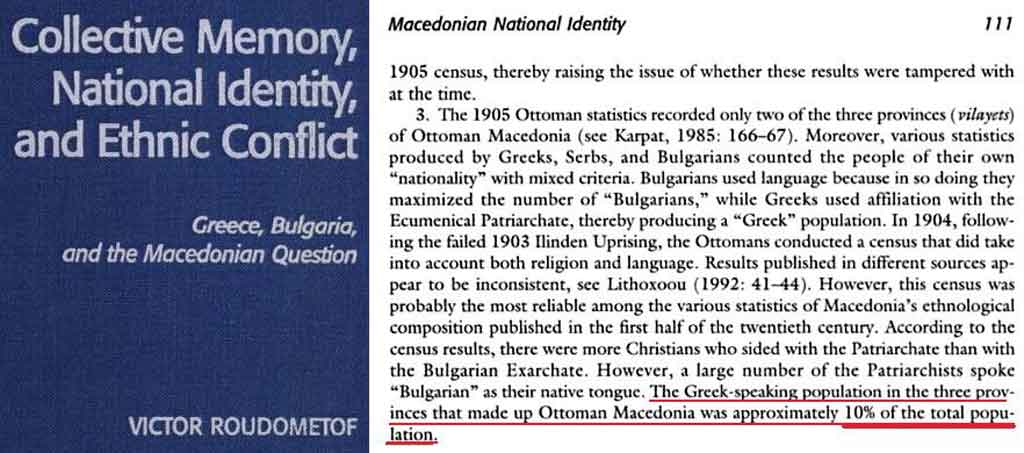
 Victor Roudometof examined the statistics of the Ottoman Empire in relation to "Ottoman Macedonia". According to him, in these three Ottoman provinces, only 10 percent of the total population spoke the Greek language. In a nutshell: Victor Roudometof is visiting professor at the Institute of Sociology, Gerontology and Anthropology at Miami University, Oxford, Ohio. His earlier publications include nationalism, globalization, and orthodoxy (Greenwood, 2001), which is quoted here. In that work, Roudometof briefly comments on the language distribution in Ottoman Macedonia, e.g. on all three vilayets (Ottoman administrative districts) that made up Macedonia's territories, these are also called "Macedonian vilayets". The author claims that in these three administrative districts, probably only 10% of the population spoke Greek. Quote: The 1905 Ottoman statistics recorded only two of the three provinces (vilayets) of Ottoman Macedonia. Moreover, various statistics pr...

The Myth of “Bulgarian Roots” in Macedonia - On a Pillar of Sand

Image
 Once More into the Fray To the objective observer who has followed the unending contamination of politics in Macedonia, the events that have unfolded in the country since independence can only be viewed as an absolute tragedy. In addition to being held back from economic development, the Macedonians have been robbed of their dignity and cultural heritage. The culprits responsible for this predicament are found both inside and outside of Macedonia. Although diminishing by the day, the hope of those Macedonians who have maintained their integrity is to end this nightmare as soon as possible so they can right the wrongs inflicted upon them and take back control of their destiny. However, the nightmare is not yet over. The perpetual cowardice of politicians in Macedonia has given way to greed and treachery, leading them back into the footsteps of Judas to beg for another 30 pieces. Only this time, the malevolence of Caiaphas comes not in the form of a rapacious Greece, which has quenc...